
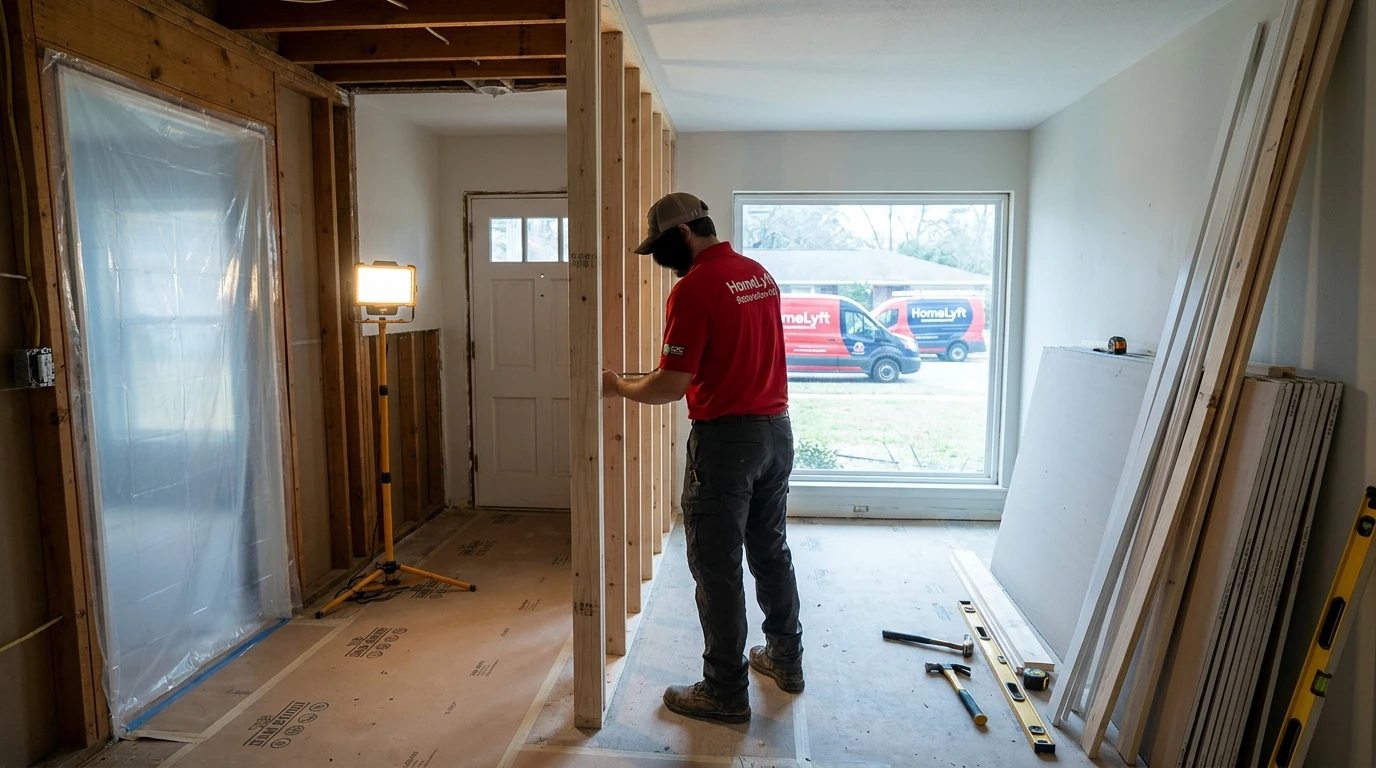
When a home needs rebuilding after storm, water, or fire damage, the mitigation crew is only half the job. The other half, framing walls back in, hanging drywall, laying new flooring, painting, matching trim, is construction work. That’s the phase where a homeowner finds out whether the company they hired can actually build, not just demolish and dry.
Here’s what one Gulfport-area customer had to say about that phase with HomeLyft Restoration MS:
“The entire HomeLyft team was very professional and great to work with. They went above and beyond to provide quality customer service and quality construction work.” , Lauren, verified Google review
That’s a short review, but it packs in four things that actually matter on a reconstruction job: professionalism, communication, effort beyond the minimum, and craftsmanship. Here’s what each of those looks like in practice.
What does “very professional and great to work with” actually mean on a job site?
On a construction job, professionalism means the crew shows up when they say they will, protects the parts of the home that aren’t under repair, and keeps the homeowner in the loop without being asked twice. It’s not a personality trait, it’s a set of habits.
That includes things like laying down floor protection before carrying lumber through a finished hallway, sealing off dust from an active work zone with poly sheeting, and giving a homeowner a heads-up before a subcontractor (electrician, plumber, flooring installer) shows up on a day they weren’t expecting. Small stuff, but it’s the difference between a job site that feels controlled and one that feels chaotic.
Communication ties directly into this. A general contracting job on a restoration property usually runs through multiple trades and often an insurance adjuster. When the lead point of contact updates the homeowner on schedule changes, material delays, or scope adjustments before they become surprises, that’s what “great to work with” is describing.
What does “quality customer service” look like when the job also involves an insurance claim?
Quality customer service on a reconstruction job usually means someone is translating between the insurance paperwork and the actual work happening in the house. Homeowners rarely speak fluent claims-adjuster, and they shouldn’t have to.
That typically looks like a written scope of work that lines up with what the insurance carrier approved, photo documentation at each phase (pre-construction, mid-build, final), and a single point of contact who can answer “why is this taking three weeks” without making the homeowner track down three different subcontractors. If a supplement is needed, because hidden damage showed up once walls were opened, the contractor should be the one drafting that request, not leaving the homeowner to figure out how.
Good customer service on this kind of job isn’t about friendliness for its own sake. It’s about reducing the number of things the homeowner has to manage during an already stressful rebuild.
What separates “quality construction work” from a job that just gets closed out?
Quality construction work means the finished space matches or improves on the original, passes inspection, and holds up under normal use, not just looks fine on handoff day. That’s measured in things a homeowner can check.
On a drywall and paint job, that means seams that don’t show through in raking light and texture that matches the surrounding wall. On flooring, it means transitions that sit flush and no hollow spots under tile or LVP. On any structural framing, it means work that passes a local building inspection, not just a visual check. OSHA sets the safety standards crews are trained to follow on active job sites, and a licensed general contractor is working under Mississippi’s state licensing requirements, not just company policy.
The other marker of quality construction: a final walkthrough where the contractor points out the work rather than the homeowner having to hunt for problems. If a punch list comes up, whether it’s a paint touch-up or a door that needs adjusting, addressing it before the job is marked complete is part of the standard, not an extra favor.
How do you know a general contractor will handle your rebuild this way before you hire one?
Ask for a written scope of work and a project timeline before signing anything, and ask who your single point of contact will be for the duration of the job. Vague verbal estimates and “we’ll figure it out as we go” are the two biggest red flags on a reconstruction project.
It’s also worth asking directly whether the same company handling your mitigation (water extraction, mold remediation, fire cleanup) also handles the rebuild, or whether you’re going to be coordinating between two separate companies. One continuous point of accountability from demolition through final paint tends to produce fewer miscommunications and fewer delays. For homeowners weighing that decision, our guide on choosing a restoration company covers the questions worth asking before you sign a contract.
If your property needs rebuilding after storm, water, or fire damage, request a written scope of work before construction starts. That single document is what keeps a rebuild on schedule and keeps everyone, homeowner, contractor, and adjuster, working from the same plan.
About HomeLyft Restoration MS
HomeLyft Restoration MS is an IICRC-certified firm serving Gulfport, Mississippi and the surrounding Gulf Coast since 2022 (license RO 2728). Their crews handle general contracting and reconstruction alongside water damage restoration, fire damage restoration, mold remediation, storm damage restoration, and roofing across the region.